help me help you
Equipping community partners with tools and resources can help states successfully implement H.R. 1 Medicaid work requirements

Every state relies on community partners.
Navigators, community health workers, disability organizations, immigrant-serving organizations, food banks, housing organizations, religious institutions, and many other trusted community-based groups help millions of residents understand and navigate public systems every day.
When community partners are informed, prepared, and equipped to help, residents are more likely to receive accurate information, navigate change with confidence, and maintain access to the benefits they need.
For states implementing H.R. 1’s Medicaid and SNAP work requirements, preparing community partners may be one of the most important opportunities for investment.
Download resources to support community partners and register for our August 5 demo walking through new resources and tools.
why community partners matter
Civilla’s H.R. 1 team has been collaborating with the Michigan Health Endowment Fund to explore how community partners can best support the implementation of new rules in H.R. 1. Through our research, we found that community partners are uniquely positioned to support residents during periods of change because they combine something that is difficult for any system to replicate at scale: trust and context.
Many community partners have worked alongside the same residents for years. They understand the circumstances residents are navigating, the barriers they face, and the questions they are likely to have. They’re often supporting people who are already managing multiple challenges, including disabilities, housing instability, language barriers, transportation challenges, or complex family situations.
When policies change, residents are often looking for more than information. They’re looking for reassurance that they understand the situation correctly and confidence that they’re taking the right next step.
Community partners are uniquely positioned to provide that support because they can connect policy information to a resident’s specific circumstances in a way that feels relevant, relational, and actionable. While agencies must communicate with millions of residents, community partners are often able to sit with individuals and help them understand what a policy means for their household, their coverage, and their future.
Throughout our work, we repeatedly saw community partners serving as translators, guides, and problem-solvers. They were helping residents navigate uncertainty and making complex systems feel more manageable.
what happens when community partners are not supported?
While community partners play a critical role in helping residents navigate change, many described feeling underprepared when major policy changes occur.
Several partners shared that they learned about changes at the same time as the public. As a result, they were trying to understand evolving policies while simultaneously answering urgent questions from residents and preparing staff.
Without clear information, training, or guidance, community partners spend significant amounts of time trying to interpret policy themselves, create materials from scratch, or search for answers across multiple sources. This not only places additional strain on organizations that are already operating with limited capacity but can also create challenges for residents seeking support.
When community partners are uncertain, residents are more likely to receive inconsistent information. That can cause people to contact state offices seeking clarification, increasing the workload for eligibility specialists. Residents may miss important steps or deadlines while trying to determine what actions they need to take.
Community partners consistently described wanting to help residents navigate change successfully. What they often lacked was not commitment, but the information, preparation, and support needed to do so confidently.
plain language website
Like residents, community partners want a trusted source of information. Many described spending significant time piecing together guidance from multiple sources and wanted one place they could rely on for clear, accurate, and up-to-date information.
To support them, Civilla created a detailed plain-language Medicaid work requirements page. Download the HTML files and Word docs of the content here.
The page focuses on helping community partners break down the complex policy into simple parts that they can use to ease residents’ anxiety about the new requirements. Community partners can also point residents to the website as a reference for all of their unanswered questions such as: who do work requirements apply to? How do I meet them? What if I can’t? Do I need proof?
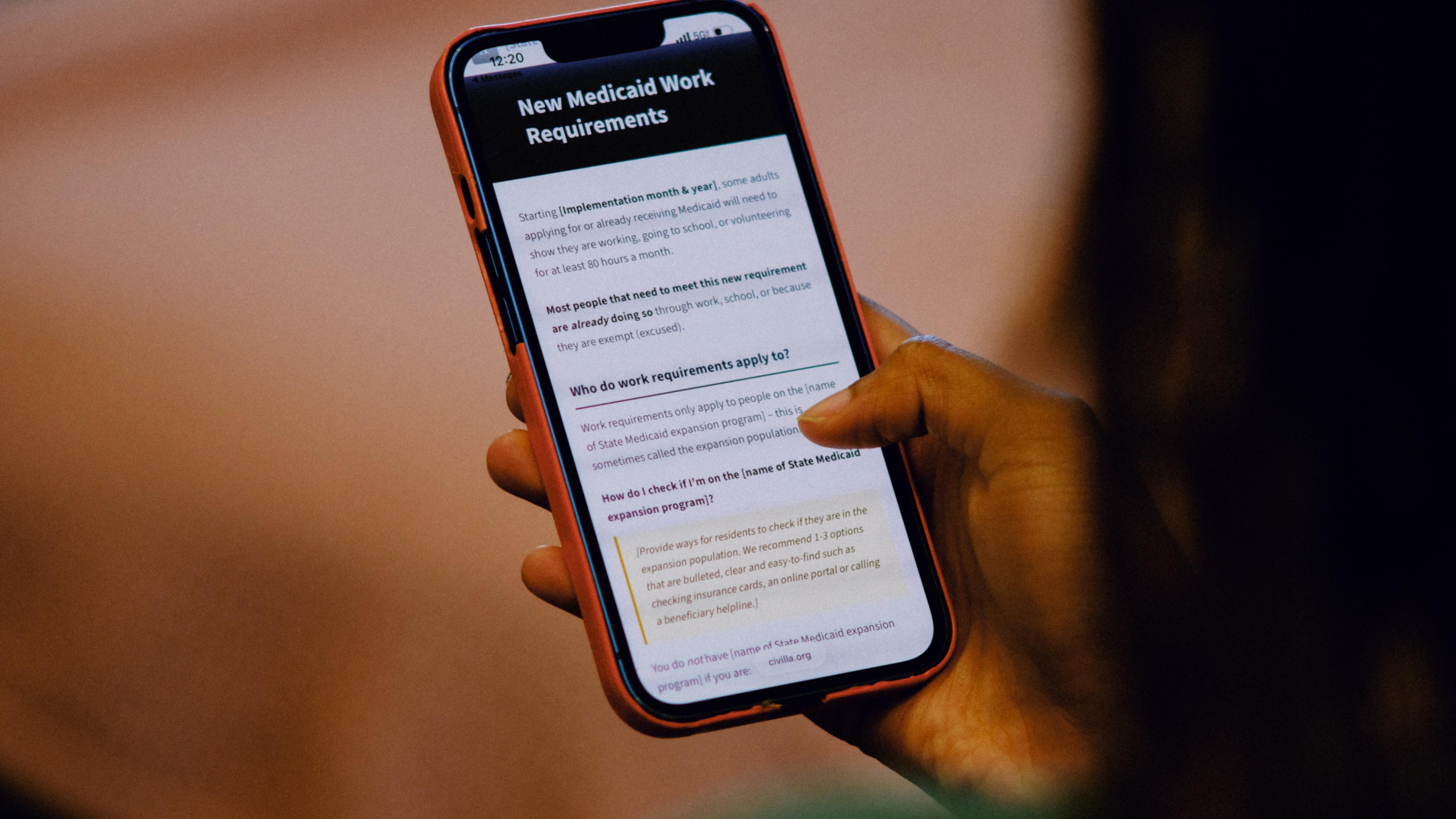
“it definitely gives me the confidence [that] I know what to expect now and I know what I should do.”
- community partner
webinar series strategy
Community partners want to be strong allies in this work, and the more supported and informed they feel, the more effective they can be in helping residents maintain coverage. Partners consistently emphasized that they should not be hearing about major policy changes at the same time as residents. They wanted opportunities to understand upcoming changes, train staff, and prepare resources before public rollout began.
For states that are willing to proactively engage community partners, a communication and training strategy can prepare community partners to answer complex questions from residents. To support states, Civilla created a communication and support ecosystem, including:
- A webinar strategy for state teams to use to engage community partners
- Slide decks states can use for a 3-part webinar training with community partners
- A communication timeline for informing residents about work requirement changes
- A 1-pager that community partners can use immediately with staff and residents.
“It’s hard to have any comments because it's so comprehensive.”
- community partner
digital interactive guide
Community partners and residents need practical guidance to understand how policy changes apply to them. Policy summaries were helpful, but partners asked specifically for help understanding how policies would apply to real situations and real households. They wanted examples, scenarios, and tools that could help them answer the questions residents would bring to them.
A common tool to address this issue is a resident-facing screener that allows people to walk through a series of questions on their own to determine how rules apply to them. In talking with community partners, a common worry was “garbage in, garbage out”, meaning that partners felt like they couldn’t trust the results residents reported from screeners because they couldn’t be sure that residents had accurately answered the questions.
Our solution was to create a screener that’s not a screener. Instead of a tool residents use on their own, Civilla’s digital interactive guide is designed to be used side-by-side with residents and community partners to ensure accuracy and increase trust in the results. Knowledgeable community partners can also use it as an educational tool on their own to test residents' scenarios and better understand the new rules.
The tool allows users to assess multiple household members at once and dynamically updates results in real time, so users can adjust scenarios without hitting a submit button. When someone has entered all their information, they get a printable or downloadable summary of next steps. The tool does not store or collect any information and does not require an account or log in to use. Try the tool out for yourself or download the HTML code file and content document.

“this cuts the work in half…I'm really in love with [the] workflow tool, to be honest. I think that's going to be a God-send for us.”
- community partner
invest in partners to support change
Community partners are a vital but often overlooked resource for state leaders who want to relieve strain on state staff while providing a more personalized, trusted experience for residents navigating benefit eligibility rules. Investing in community partners is not simply about providing information. It is about recognizing the role they already play and ensuring they have the tools, context, and preparation needed to support residents effectively.
The changes in H.R. 1 are especially significant, and states and residents would be well-served by engaging community partners as collaborators in the effort to maintain their coverage. By adapting the resources Civilla has created to work within their own context, states can do this even with little capacity and tight timelines.